
Halloween History, Traditions and Modern Trends Around the World
Halloween began as a seasonal crossroads and grew into a holiday with many faces. Its best traditions—from turnip lanterns and barmbrack to trick-or-treating—travel differently from country to country. New surveys show how people celebrate now, where the holiday is strongest, and why its future may depend on balancing fun, cost and local custom.
Before it was a pumpkin, the Halloween lantern was a turnip. The National Museum of Ireland has a carved “ghost turnip” that came into its collection in 1943, a reminder that the familiar orange pumpkin is only one version of a much older custom. Halloween’s ability to travel and change is part of its story: a night tied to harvest and the dead became a neighborhood ritual, a costume party and, eventually, a major retail season.
The history is layered, not simple
Confirmed history: Halloween is observed on October 31, the eve of All Saints’ Day, also called All Hallows’ Day. Its roots are commonly traced to Samhain, a Gaelic seasonal festival marking the turn toward winter around November 1. The name “Halloween” comes from All Hallows’ Eve. Historians describe a mingling of customs over time, rather than one ancient festival surviving unchanged under a new name.
At Samhain, people were said to believe that the boundary between this world and the spirit world grew thin. They lit fires, left food offerings and wore disguises, according to accounts of the customs. The seasonal change was the heart of it: the harvest was ending, the darker half of the year was beginning, and familiar rules felt a little less firm. “Samhain is really the marker of the end of a season,” says Dr. Kelly Fitzgerald, head of the School of Irish, Celtic Studies and Folklore at University College Dublin, in an interview with Tourism Ireland.
It’s a night that reflects our deepest anxieties about life and death, and how we ritualize those fears
Jeremy Cohen, Religious Studies professor
Christian observances added another layer. All Saints’ Day fell on November 1, followed by All Souls’ Day on November 2. In parts of Ireland and Scotland, customs such as “guising” brought masked visitors to neighbors’ doors. In England and Ireland, “souling” involved people asking for food and, in return, offering prayers for the dead. These practices help explain later door-to-door visits, though modern trick-or-treating did not simply arrive intact from ancient times. The phrase appeared in the United States in the 1920s; the custom became widely popular after World War II. Irish and Scottish immigrants brought Halloween customs to the United States in large numbers from the mid-19th century onward.
Customs worth keeping
The best traditions, to my mind, are the ones that make the evening feel local. In Ireland, that might mean a turnip lantern or barmbrack, a fruit bread sometimes baked with a ring or coin inside. A party game, an old ghost story, a bonfire or a bowl of apples can do more to make Halloween memorable than a shopping bag full of plastic decorations.

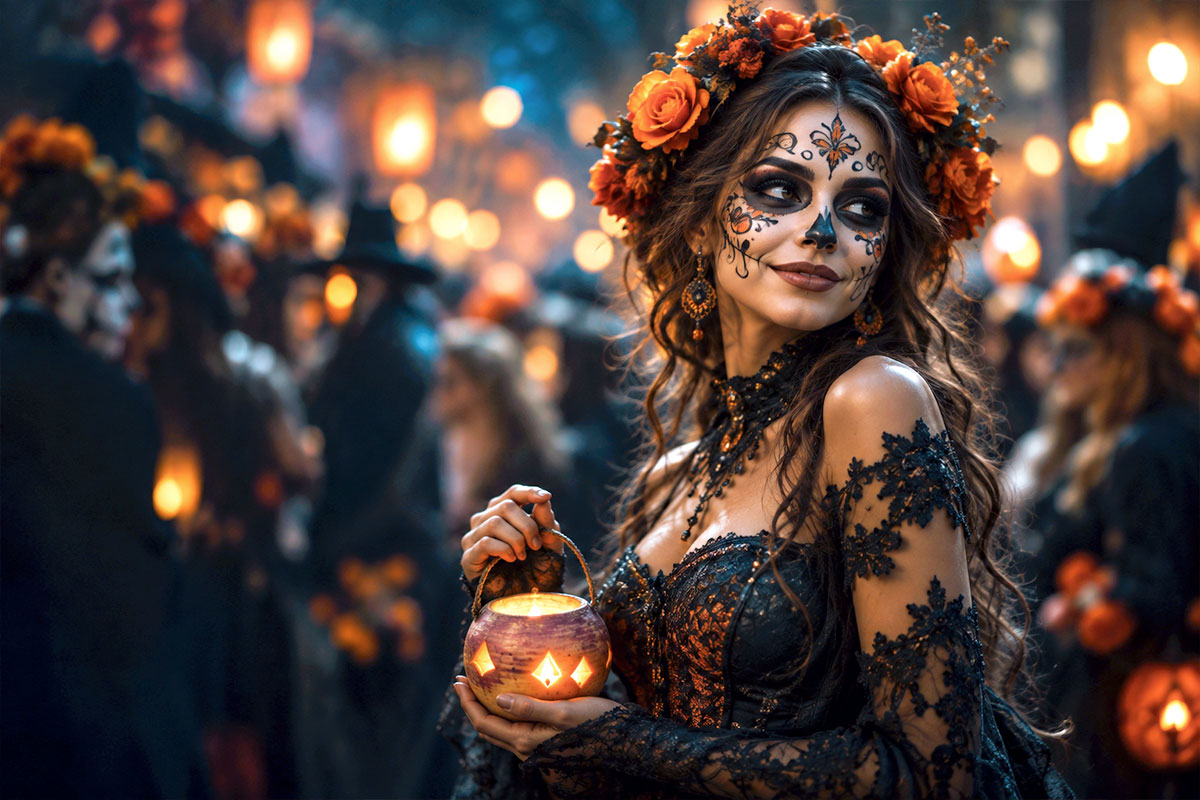
Illustration created with Adobe Firefly for illustrative purposes.
The National Museum of Ireland sums up the holiday’s continuing place in Irish life: “The eve of this day, Oíche Shamhna, Hallowe’en, is still celebrated all over Ireland with feasting and games.” In the United States and Canada, the classic neighborhood circuit still has its own charm: a homemade costume, a lit porch, a walk with the kids, then a quick sort of the sweets on the kitchen floor. And yes, carving a pumpkin remains a good tradition. It is just not the only one.
We have introduced Halloween back to adults, with costume parties, beginning largely in the 1960s-70s
Jeanmarie Rouhier-Willoughby, Folklorist
Today, Halloween lasts longer than one night
Confirmed survey result, with a caveat: the latest U.S. National Retail Federation (NRF) survey found that 74% of consumers planned to celebrate Halloween in 2026, compared with 68% in 2019. The same survey projected spending of $13.5 billion this year, near its 2025 estimate of $13.1 billion. Those dollar figures are forecasts based on shopping plans, not a final tally of money spent. NRF and Prosper Insights & Analytics surveyed 7,889 people from September 1–9; the survey’s stated margin of error is plus or minus 1.1 percentage points.
What do people plan to do? Hand out candy (61%), dress in costume (50%), decorate their home or yard (42%), carve pumpkins (42%) and watch scary movies (42%) are the leading activities. The survey’s estimate of average spending is $115.14 per person. Candy remains the most popular planned purchase, while costumes and decorations are expected to account for more money overall.
Organization statement: NRF Vice President of Industry and Consumer Insights Allison Zeller said, “Consumers continue to make Halloween a spending priority, but they are also approaching the season with affordability in mind.” That fits the survey’s other figures: 31% of respondents said they would compare prices if Halloween items cost more than expected, and 34% said they would look for items they could reuse or repurpose.
The “season” part is real, too. Nearly half of U.S. respondents planned to begin shopping in September or earlier, up from 34% in 2016. One newer shopping habit is the use of AI: 47% said they were using AI tools to help with Halloween shopping, often to brainstorm ideas or get recommendations. Yet the costumes are not all new internet-born characters. Witches and vampires topped NRF’s adult costume list, while Spider-Man led the children’s list. The blend is very Halloween: a fresh trend beside the witch who has been showing up for generations.
Where Halloween is big—and where it is smaller
The United States is a clear heavyweight by participation and retail spending: NRF’s 2026 survey found 74% planning to celebrate, with spending projected at $13.5 billion. Great Britain has a smaller share in its latest survey: 49% of adults said they celebrate Halloween, while 51% said they do not. Among celebrators there, 28% planned to hand out sweets, 24% to watch Halloween films and 22% to carve pumpkins.
Canada sits somewhere in between on one 2025 measure. Leger found that 31% of adults planned to celebrate; among households with children old enough to go trick-or-treating, 80% planned to do so. In Australia, an Australian Retailers Association and Roy Morgan survey found that more than one in five adults—about 4.8 million people—were gearing up for Halloween. These figures make the holiday look less widespread than in the United States, but the surveys use different questions and methods, so they are not a precise country ranking.
A 2025 Recruit Hot Pepper survey of adults aged 20–69 in Japan’s Kanto, Tokai and Kansai regions found that 15.7% planned to take part in Halloween events, a second yearly decline. It’s a useful sign that participation can be more limited, even where the holiday is visible. And Mexico needs a different kind of care in this conversation: Día de los Muertos is related in calendar and imagery, but it is a distinct tradition, centered on remembering the dead and welcoming them through family observances such as ofrendas. Treating it as simply another Halloween would miss what makes it meaningful.
What may shape Halloween’s next chapter
Announced future plans: Ireland is putting its historical connection to Halloween at the center of a growing autumn festival season. Fáilte Ireland announced a 2026 programme spanning seven destination hubs, alongside the Púca Festival and Derry Halloween. The official Visit Derry site lists the city festival for October 28–November 1, 2026, its 40th anniversary. Fáilte Ireland reported that its 2025 programme supported more than 830 events, attracted over 322,000 visitors and generated more than €43 million in economic impact. Those are the agency’s reported figures, not an independent audit cited here.
Prediction and analysis: Halloween will probably keep stretching across the calendar, pulled along by early shopping, pop-up attractions and festivals that give people a reason to make a weekend of it. But cost pressure may push in the other direction, toward homemade costumes, shared decorations and one small neighborhood ritual instead of an expensive night out. That is not a bad trade. The challenge is to make the season welcoming without sanding away the stories that give it character.
A turnip with a crooked face still says plenty. Halloween can be enormous, commercial and loud; it can also be a game, a loaf of bread or a porch light left on for the children next door.
Previous Post
Next Post











Advertisement