












Now Reading: GTA 6 at 30 FPS on Consoles: The Shocking Truth Behind the Performance Decision
-
01
GTA 6 at 30 FPS on Consoles: The Shocking Truth Behind the Performance Decision
GTA 6 at 30 FPS on Consoles: The Shocking Truth Behind the Performance Decision


GTA 6 is targeting 30 FPS on PS5 and Xbox Series X|S, raising questions about performance and visual quality. Discover why Rockstar's ambitious open world makes higher frame rates challenging, what the PS5 Pro offers, and whether players could eventually experience GTA 6 at 60 FPS.
Imagine flying a helicopter over Vice City, watching the coastline stretch into the distance while sunlight reflects off skyscrapers and boats move across the water below. The world looks incredible, but there’s something you might notice when turning the camera: the movement isn’t quite as smooth as you’d expect from a modern console game. This is a hypothetical gameplay scenario rather than a confirmed sequence from Rockstar’s footage, but it illustrates the balance between visual detail and smooth performance.
That’s the kind of trade-off players could experience when Grand Theft Auto VI arrives on November 19, 2026. Rockstar Games has officially confirmed that GTA 6 targets 30 frames per second on PlayStation 5 and Xbox Series X|S, with no higher frame-rate target announced for the more powerful PS5 Pro.
For some players, that news is disappointing. After all, 60 FPS has become increasingly common in modern console gaming, and GTA 6 has been in development for years. You might reasonably expect one of the most anticipated games of the generation to offer a performance mode. Yet Rockstar’s announcement emphasizes environmental density and visual fidelity, suggesting that these are major priorities behind the game’s 30 FPS target.
Why GTA 6’s 30 FPS Decision Is Such a Big Deal
On November 10, 2026, Rockstar published an official announcement confirming GTA 6’s console performance target. The company explained that the game was developed from the ground up for current-generation hardware, with a particular focus on maintaining the richness and visual quality of Leonida, the fictional state containing Vice City.
Targeting 30 frames per second while pushing both platforms to their absolute limitsRockstar
That statement settled months of speculation about whether GTA 6 would offer 60 FPS on consoles. However, targeting 30 FPS doesn’t automatically guarantee perfectly stable performance in every situation. Frame-rate stability, consistency, and input responsiveness will require independent testing once the finished game becomes available.
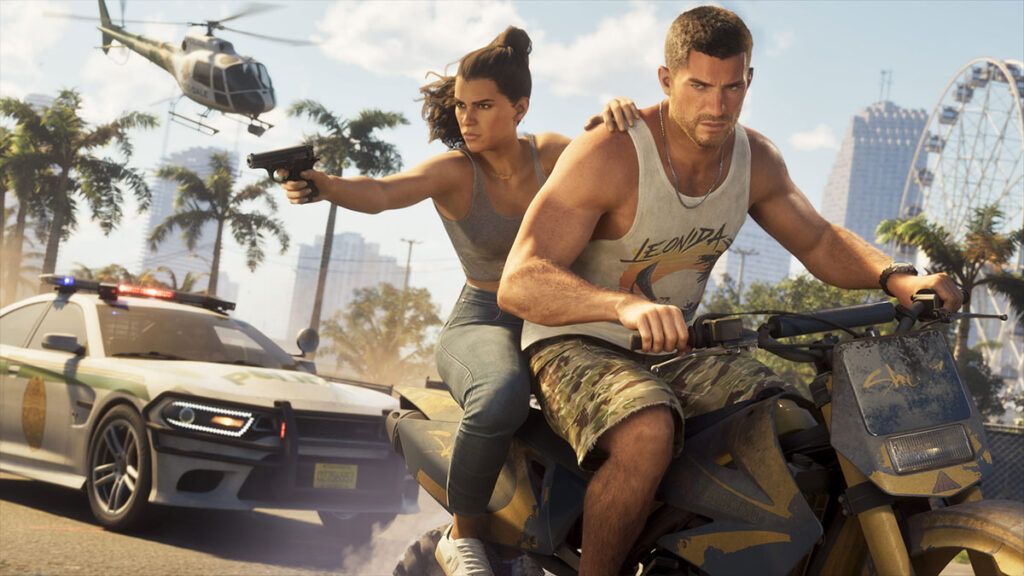
Image: Official Grand Theft Auto VI screenshot published by Rockstar Games via the Rockstar Games website.
The timing of the announcement was particularly interesting because Rockstar had already released approximately 26 minutes of gameplay during its August 27 presentation, Grand Theft Auto VI – An Extended Look. According to Rockstar’s description, the footage was captured entirely from the standard PlayStation 5 version. It showcased detailed urban environments, sophisticated lighting, realistic character animation, and an ambitious open world filled with activity.
Technical experts quickly began examining how Rockstar was achieving those results on existing console hardware.
One of the most extraordinary visual accomplishments ever seen in real-time game graphicsDigital Foundry
The assessment appears in Digital Foundry’s official podcast description. However, this praise shouldn’t be confused with confirmation of GTA 6’s exact hardware requirements. While technical analysis suggests that maintaining such a detailed world at 60 FPS could be challenging, Rockstar hasn’t publicly identified the specific processing limitations behind its decision.
Does 30 FPS Automatically Mean a Worse Experience?
Not necessarily. A game running at a consistent 30 FPS can still feel responsive and enjoyable, especially when developers carefully manage animation, input response, and frame pacing. However, there’s a noticeable difference between 30 and 60 FPS. Higher frame rates generally provide smoother camera movement, clearer motion, and more frequent visual feedback from player inputs.
These differences become especially apparent during fast-moving gameplay. Driving through narrow streets, aiming during gunfights, or quickly changing camera direction can feel more immediate at 60 FPS. For players who regularly choose performance modes in modern console games, returning to 30 FPS may require some adjustment.

Image: Official Grand Theft Auto VI screenshot published by Rockstar Games via the Rockstar Games website.
Still, frame rate isn’t the only factor determining how a game feels. A stable 30 FPS experience with consistent frame delivery can sometimes feel better than an unstable performance mode that frequently fluctuates between higher and lower frame rates. The real challenge for Rockstar is ensuring that GTA 6 feels polished and responsive enough for players to enjoy its ambitious world without constantly noticing the lower frame rate.
How GTA 6’s 30 FPS Target Affects Performance
Here’s the technical detail that explains much of the controversy. At 30 FPS, the system has approximately 33.3 milliseconds to produce each frame, while at 60 FPS, that processing window shrinks to about 16.7 milliseconds. It might seem like an insignificant difference, but those milliseconds determine how much work the console can complete before displaying the next image.
Think back to the hypothetical helicopter scenario from the introduction. As the player travels above Vice City, the game engine must continually render changing environments while managing aircraft physics, environmental effects, and gameplay systems. The challenge isn’t simply displaying a detailed city from above, but maintaining a consistent experience as the player moves through it and makes unpredictable decisions.
Unlike a carefully controlled cinematic sequence, an open-world game must accommodate unexpected player actions. Someone might suddenly fly toward a crowded neighborhood, crash into a building, or abandon the helicopter entirely. The engine needs to respond to these decisions while maintaining a convincing environment and avoiding disruptive performance problems.
That additional processing time at 30 FPS can help the hardware accommodate demanding rendering and simulation tasks, although it doesn’t reveal exactly how GTA 6 distributes its workload. The helicopter example illustrates the challenges of building a detailed open world rather than confirming the internal workings of Rockstar’s game engine. Without published performance benchmarks, it’s impossible to identify which individual systems place the greatest demands on the CPU and GPU.
Why Lower Graphics Settings May Not Deliver 60 FPS
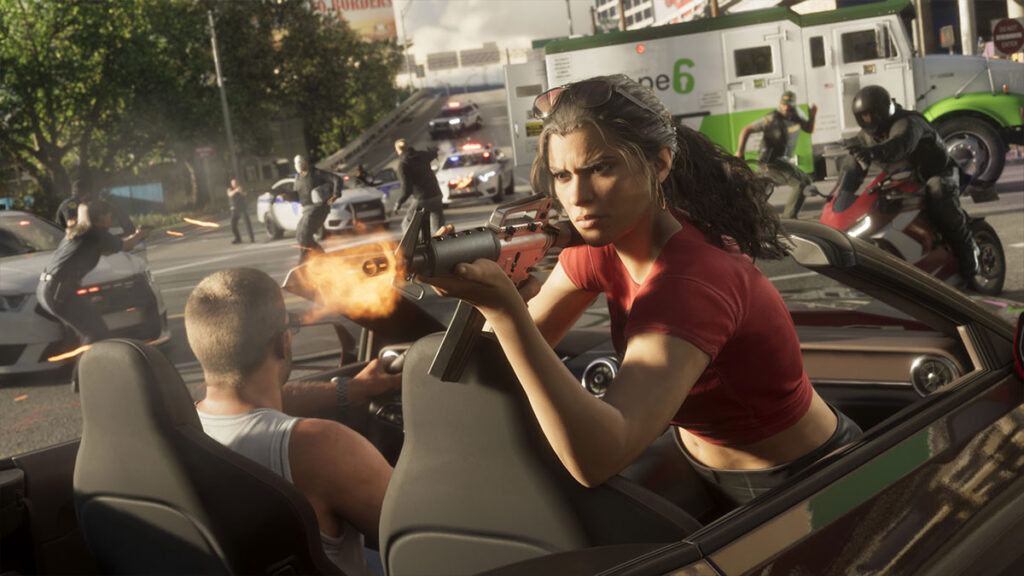
Image: Official Grand Theft Auto VI screenshot published by Rockstar Games via the Rockstar Games website.
A common argument among players is that Rockstar should simply reduce the graphics settings and offer 60 FPS. That approach works in many games, but it isn’t always enough for large open-world simulations. The reason involves the difference between CPU and GPU workloads, which affect gaming performance in different ways.
The GPU handles much of the visual rendering, including lighting, shadows, textures, and image processing. Reducing resolution or certain graphical effects can significantly decrease its workload. The CPU, meanwhile, manages numerous gameplay operations such as artificial intelligence, physics, game logic, and interactions between simulated objects.
If a game is limited primarily by CPU performance, reducing its resolution won’t necessarily provide enough additional processing capacity to reach 60 FPS. This is particularly relevant to ambitious open-world games, where artificial intelligence, physics, and background simulation can place significant demands on the processor. Developers can reduce or simplify certain calculations to improve performance, but Rockstar hasn’t explained exactly how GTA 6 manages these systems or which components create its biggest performance challenges.
Digital Foundry’s analysis highlighted the technical complexity visible in Rockstar’s gameplay presentation, including sophisticated rendering techniques and detailed environmental simulation. However, it’s important to distinguish expert analysis from official confirmation. Rockstar hasn’t specifically identified CPU limitations as the deciding factor behind its 30 FPS target, meaning the exact performance bottlenecks remain unknown.
PS5 Pro, Xbox Series X, and Series S: Will the Experience Be Different?
Despite the PS5 Pro’s additional graphics-processing power, Rockstar hasn’t announced a separate 60 FPS performance mode for the upgraded console. Instead, the confirmed enhancements focus on visual quality, including PlayStation Spectral Super Resolution (PSSR) and exclusive ray-traced shadows. PSSR improves image clarity through AI-assisted upscaling, while ray-traced shadows can produce more realistic shadow effects. However, because the PS5 Pro’s CPU architecture remains closely related to the standard PS5, additional GPU power doesn’t necessarily remove every performance limitation.
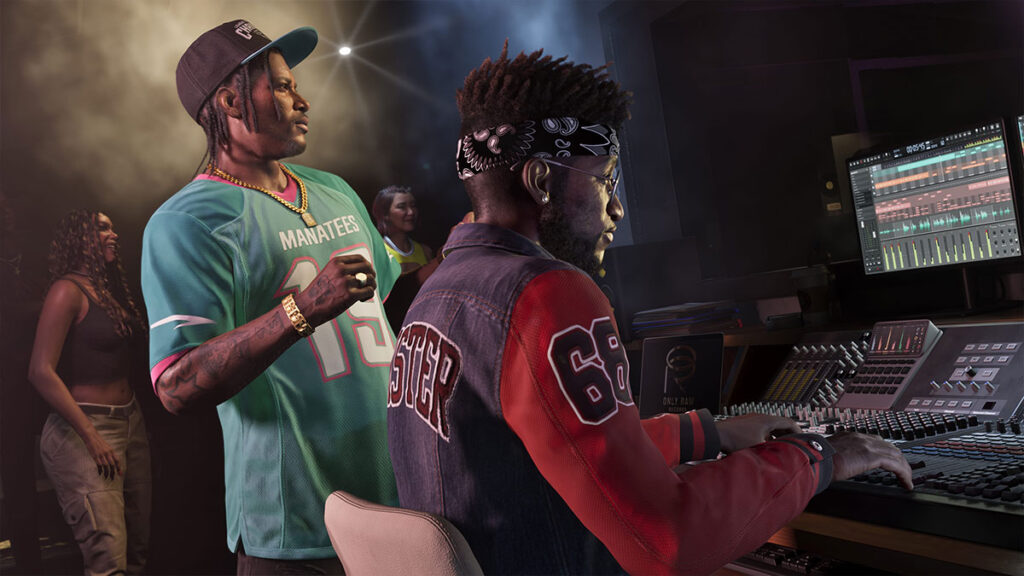
Image: Official Grand Theft Auto VI screenshot published by Rockstar Games via the Rockstar Games website.
Here’s what Rockstar and Sony have officially confirmed about the console versions:
- PlayStation 5: Targets 30 FPS and supports DualSense haptic feedback, adaptive triggers, spatial audio, and improved loading.
- PlayStation 5 Pro: Shares the announced 30 FPS target while offering PSSR image upscaling and exclusive ray-traced shadows.
- Xbox Series X: Falls under Rockstar’s 30 FPS console target, although exact rendering specifications haven’t been published.
- Xbox Series S: Also falls under the announced console target, but detailed graphical differences remain unconfirmed.
Sony outlined the PlayStation-specific features in its November 10 announcement. The Xbox Series S version will be particularly interesting to examine because the console has considerably less graphics-processing capability than Series X. Rockstar may need to adjust certain graphical settings to maintain its performance target, but the specific compromises haven’t been confirmed.
Rockstar has also announced Xbox Cloud Gaming support, allowing compatible Xbox One systems to stream GTA 6 using Xbox Series S graphics settings. This doesn’t mean the game runs natively on Xbox One, and streaming performance can be affected by connection quality and latency.
It’s worth remembering that a shared 30 FPS target doesn’t automatically mean every console version will look or perform identically. Rendering resolution, image quality, frame pacing, and graphical settings can influence the overall experience. Those differences will become clearer once independent reviewers can examine the finished game across all supported hardware.
Could GTA 6 Eventually Reach 60 FPS?
Although Rockstar’s announcement confirms the current console target, it doesn’t necessarily tell us what might happen several years from now. The developer has previously introduced significant technical improvements to older games, and GTA 5 provides a useful example. Originally released on PlayStation 3 and Xbox 360 in September 2013, it later received enhanced editions across subsequent console generations.
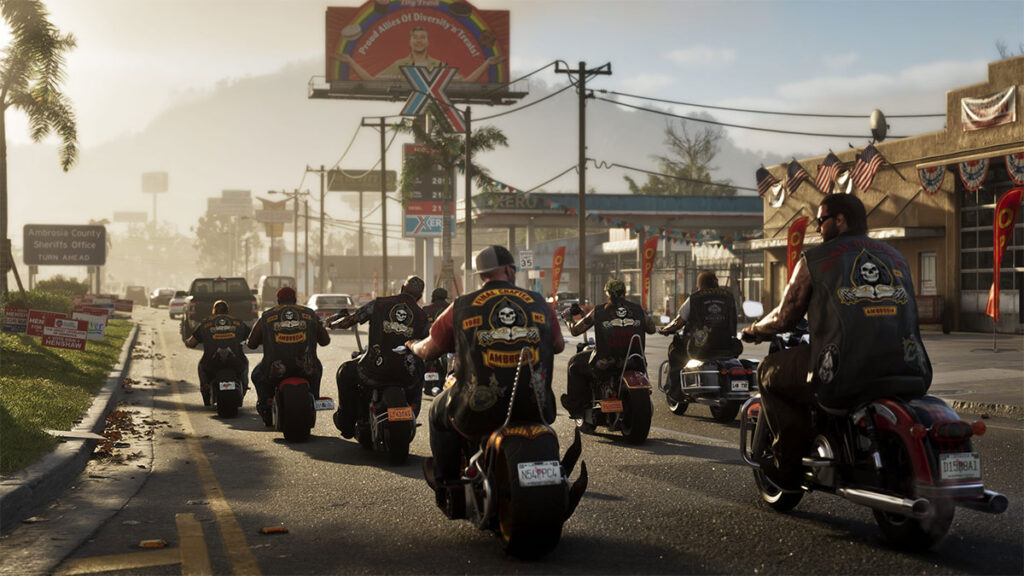
Image: Official Grand Theft Auto VI screenshot published by Rockstar Games via the Rockstar Games website.
When GTA 5 arrived on PS5 and Xbox Series X|S in March 2022, the updated versions introduced performance modes capable of reaching 60 FPS. Rockstar confirmed those improvements in its official announcement. Naturally, that history has encouraged speculation about GTA 6 eventually receiving similar enhancements.
However, there’s an important difference between something being technically possible and Rockstar actually announcing plans to deliver it. The company hasn’t confirmed a 60 FPS update for GTA 6, and there’s no reliable timetable for such a feature. Whether it becomes practical will depend on the game’s underlying performance requirements and the capabilities of future hardware.
Another possibility is a 40 FPS mode, which could offer a middle ground between visual quality and smoother gameplay. At 40 FPS, the console has 25 milliseconds to produce each frame, giving developers more processing time than 60 FPS while improving motion smoothness compared with 30 FPS. On compatible 120 Hz displays, this approach can provide evenly spaced frames and has already been implemented in several modern console games.
For GTA 6, such a mode might improve responsiveness without requiring all the compromises associated with targeting 60 FPS. But this remains speculation, and Rockstar hasn’t announced plans to support it. Players shouldn’t assume that a 40 FPS option will arrive through a future update simply because other developers have implemented similar features.
There’s also the possibility of a PC release. As of November 14, 2026, GTA 6 has only been officially announced for PS5 and Xbox Series X|S, with no confirmed PC launch date. More powerful PC hardware could eventually provide additional performance options, although even high-end systems aren’t guaranteed to maintain 60 FPS in demanding open-world games.

Image: Official Grand Theft Auto VI screenshot published by Rockstar Games via the Rockstar Games website.
Until Rockstar announces a PC version or additional console performance modes, higher frame rates remain a possibility rather than a confirmed feature. For players planning to purchase GTA 6 at launch, the officially announced 30 FPS target is the most reliable expectation.
What Will Actually Matter When GTA 6 Launches?
The frame-rate discussion has become unusually important because GTA 6 is arriving with enormous expectations. According to Sony’s November 10 announcement, GTA 6 has become the most pre-ordered game in PlayStation Store history. That’s Sony’s own reported milestone, rather than an independently verified industry-wide sales ranking, but it illustrates the extraordinary attention surrounding Rockstar’s upcoming release.
Players are approaching GTA 6’s launch with different expectations. Some will prioritize visual detail, atmosphere, and the freedom to explore Leonida, while others will focus on smooth camera movement, frame-rate stability, and responsive controls. Neither perspective is unreasonable, and the game’s success won’t depend on frame rate alone. What ultimately matters is whether Rockstar delivers an experience that remains consistent and enjoyable during both quiet exploration and demanding action sequences.
Once GTA 6 launches on November 19, independent technical analysis should answer several questions that Rockstar’s announcement doesn’t fully address. Reviewers will be able to measure how consistently the game maintains its frame-rate target during demanding situations, whether frame pacing remains stable, and how image quality differs across consoles. They can also examine whether the additional visual enhancements on PS5 Pro produce a noticeably better experience than the standard PS5 version.
Related Posts

Previous Post
Next Post
Previous Post
Next Post














Advertisement