
















Now Reading: Best Budget Cameras for Photography in 2026: Affordable Picks Worth Buying
-
01
Best Budget Cameras for Photography in 2026: Affordable Picks Worth Buying
Best Budget Cameras for Photography in 2026: Affordable Picks Worth Buying


Shopping for a camera in 2026 means balancing price, autofocus, lenses, and how much gear you'll actually carry. We compare seven genuinely useful options, from Canon's affordable R100 to Nikon's capable Z50II and Fujifilm's creative X-T30 III, using verified European prices and practical advice for photographers.
Canon’s EOS R100 comes with an interchangeable lens for €599, while the more advanced EOS R50 kit costs €849. That’s a €250 difference between two cameras that, at first glance, look remarkably similar. Both have APS-C sensors, both can produce beautiful photographs, and both are considerably more affordable than professional mirrorless cameras.
So why spend more?
That’s the interesting thing about buying a budget camera in 2026. Image quality isn’t the whole story anymore. Autofocus, lens availability, stabilization, and how comfortable a camera feels in your hands can make a bigger difference than a few extra megapixels.
And with manufacturers introducing genuinely capable entry-level cameras, you don’t necessarily need an expensive setup to start taking photography seriously.
Why Budget Cameras Are Still Worth Buying in 2026
Smartphone cameras have become incredibly good. Computational photography automatically adjusts exposure, brightens shadows, and improves nighttime pictures, often producing attractive results without any effort.
But there’s something different about using a dedicated camera. A larger sensor gives you more flexibility in difficult lighting, interchangeable lenses open creative possibilities, and physical controls make learning photography more satisfying.
Of course, camera prices have risen. Even entry-level mirrorless kits can now cost €800–€1,200, making the word “budget” somewhat relative. Fortunately, older models, discounted kits, and refurbished cameras still provide affordable ways into photography.
The market has also changed. Traditional entry-level DSLRs have largely given way to mirrorless systems, which increasingly offer subject-recognition autofocus, electronic viewfinders, and sophisticated automatic shooting modes.
For this guide, we’re concentrating on cameras costing approximately €500–€1,150, including usable lens kits wherever possible. Prices are verified European manufacturer or retailer listings checked in November 2026. They may vary by country, availability, promotions, and local taxes.
Canon EOS R50 — Best Overall Budget Camera
Price: €849 with RF-S 18–45mm lens.
The Canon EOS R50 is probably the easiest camera to recommend to someone who wants to move beyond smartphone photography. It combines a 24.2-megapixel APS-C sensor with Canon’s Dual Pixel CMOS AF II autofocus system, a fully articulating touchscreen, and an electronic viewfinder.

Image: Canon EOS R50 in Black with RF-S18-45mm F4.5-6.3 IS STM Lens, featured in an official press release image published by Canon.
What makes it particularly appealing is how well it handles moving subjects. Whether you’re photographing children, pets, or people walking down a busy street, its autofocus can recognize and track subjects without constant manual adjustments.
The camera is also compact enough for everyday use, which matters more than people sometimes realize. A brilliant camera that stays on a shelf because it’s too heavy isn’t especially useful.
There are compromises, though. The EOS R50 doesn’t have in-body image stabilization, and the included 18–45mm zoom isn’t especially bright in low light. Still, Canon’s RF lens system has expanded, with Sigma and Tamron now offering additional APS-C options.
My take: This is the best starting point for beginners who want excellent autofocus, straightforward controls, and enough flexibility to develop their skills.
The €849 kit price comes from the official Canon Germany store.
2. Canon EOS R100 — Best Affordable Camera for Beginners
Price: €599 with RF-S 18–45mm lens.
Not everyone wants to spend close to €900 on a first camera. That’s where the Canon EOS R100 becomes interesting, offering a 24.1-megapixel APS-C sensor, interchangeable lenses, and a built-in electronic viewfinder at a considerably lower price.

Image: Canon EOS R100 in Black with RF-S18-45mm F4.5-6.3 IS STM Lens, featured in an official press release image published by Canon.
For travel photos, family gatherings, and everyday outdoor photography, it has everything necessary to produce detailed images. You can shoot JPEGs directly or capture RAW files for more control during editing.
The catch? Its rear display doesn’t support touch controls, autofocus is less sophisticated than on the EOS R50, and its video features are limited. These aren’t necessarily dealbreakers for someone who primarily wants to take photographs, but they do make the camera feel less modern.
The R100 is particularly attractive when discounted. European retailers sometimes offer it for less than the manufacturer’s listed price, making it worth comparing deals before purchasing.
My take: Choose the R100 when keeping costs down matters more than having the latest features. It’s a practical learning tool, especially when paired with a better lens later.
Canon’s official European listing confirms the €599 kit price.
3. Nikon Z50II — Best for Enthusiastic Beginners
Price: €1,149 with NIKKOR Z DX 16–50mm VR lens.
The Nikon Z50II sits at the expensive end of our budget range, but it earns its place because of its controls and autofocus capabilities. It features a 20.9-megapixel APS-C sensor, two command dials, a comfortable grip, and subject detection covering nine categories.

Image: Nikon Z50II with Nikon Nikkor Z DX 18-140mm f/3.5-6.3 VR Lens, featured in an official press release image published by Canon.
That may sound technical, but the practical benefit is simple: the camera is designed to make photography easier while giving you room to learn. You can begin with automatic settings and gradually take control of shutter speed, aperture, and exposure.
The Z50II delivers on the basics without breaking the bank
DPReview
The publication particularly praised its autofocus and handling, although it also highlighted weaker battery life, limited zoom lens options, and the absence of in-body stabilization.
Those drawbacks are worth considering. Nikon’s Z-mount offers excellent lenses, but building a complete system may cost more than the initial camera purchase suggests.
My take: For someone serious about developing photography as a long-term hobby, the Z50II is one of the most satisfying choices here.
The €1,149 kit price is published by Nikon Germany.
4. Fujifilm X-T30 III and X-M5 — Best for Beautiful Colors
X-T30 III: €1,099 with XC 13–33mm lens.
X-M5: €999 with XC 15–45mm lens.
Fujifilm cameras have a special appeal for people who enjoy the creative side of photography. Their popular Film Simulations let you adjust colors, contrast, and mood in-camera, producing distinctive JPEG images without extensive editing.

Image: Fujifilm X-T30 III with XC13-33mmF3.5-6.3 OIS Lens.
The Fujifilm X-T30 III, introduced in October 2025, combines a 26.1-megapixel APS-C sensor with the newer X-Processor 5, subject-recognition autofocus, and a dedicated Film Simulation dial. It also includes an electronic viewfinder, making it a particularly appealing option for street photography and travel.
The smaller Fujifilm X-M5 uses a similar sensor-and-processor combination but sacrifices the viewfinder to achieve a lighter, more compact design. Its fully articulating screen and video functions make it especially attractive to people who create both photographs and social media content.
A tool for the camera curious
Victor Ha, Fujifilm executive
That phrase reflects Fujifilm’s intended audience, rather than an independent assessment of its performance.
Neither model offers in-body image stabilization, so lens selection and shutter speed remain important in low light.
My take: I’d choose the X-T30 III for primarily still photography because of its viewfinder and controls. The X-M5 makes more sense if portability and video are equally important.
Prices are confirmed by Fujifilm’s European store and European X-M5 listings.
5. OM System PEN — Best Compact Camera for Travel
Price: €999 body only, or €1,099 with 14–42mm lens.
One of the more interesting camera announcements of 2026 came from OM System in September, when the company introduced its new PEN mirrorless camera.

Image: OM System PEN with 14-42mm F3.5-5.6 III Lens.
It’s compact, stylish, and designed around a roughly 20-megapixel Micro Four Thirds sensor. Unlike several competitors in this price range, it includes five-axis in-body stabilization, an electronic viewfinder, and IPX1-rated splash protection when used with compatible weather-sealed lenses.
These features are particularly useful for travel photographers. Stabilization helps when photographing stationary subjects in dim conditions, while the smaller Micro Four Thirds system supports an extensive range of relatively compact lenses.
There are trade-offs. The sensor is smaller than APS-C alternatives, and independent testing by DPReview found the PEN’s autofocus less dependable with unpredictable movement. Its creative color modes and handling, however, make it an attractive everyday camera.
The manufacturer announced European prices of €999 for the body and €1,099 for the lens kit. OM System’s Latvian store displayed these prices with preorder status when checked, so availability should be confirmed locally.
My take: This could be an excellent companion for city breaks, everyday walks, and photographers who prefer traveling light. Its portability and stabilization make a persuasive combination.
6. Sony a6400 — Best for Affordable Lens Choices
Price: approximately €789–€999 with 16–50mm lens, depending on kit and retailer.
The Sony a6400 originally arrived in 2019, making it considerably older than several cameras on this list. Yet its 24.2-megapixel APS-C sensor, capable autofocus, electronic viewfinder, and continuous shooting performance remain useful for everyday photography.

Image: Sony A6400 with Sony E 16-50mm F3.5-5.6 PZ OSS Lens.
The real advantage is Sony’s E-mount lens ecosystem. There are numerous compatible lenses from Sony, Sigma, Tamron, and other manufacturers, including budget-friendly portrait primes and versatile zooms.
That flexibility becomes increasingly valuable as you discover what you enjoy photographing. Perhaps you begin with family pictures and later develop an interest in wildlife or architecture. Having plenty of affordable lens options makes those changes easier.
The camera does have its age-related weaknesses. Its interface feels less modern than newer models, the screen is relatively limited, and there’s no in-body stabilization.
European listings have shown 16–50mm kits from around €789, while Sony Germany lists the revised a6400A kit with a 16–50mm II lens at €999.
My take: The a6400 becomes particularly compelling when heavily discounted or purchased used. Investing the savings in a high-quality lens can make a bigger difference than buying a newer body.
7. Panasonic Lumix TZ99 — Best Budget Travel Zoom Camera
Price: approximately €549.
Not everyone wants interchangeable lenses. Sometimes you just need a camera that fits into a small bag, provides a powerful zoom, and is ready whenever something interesting happens.

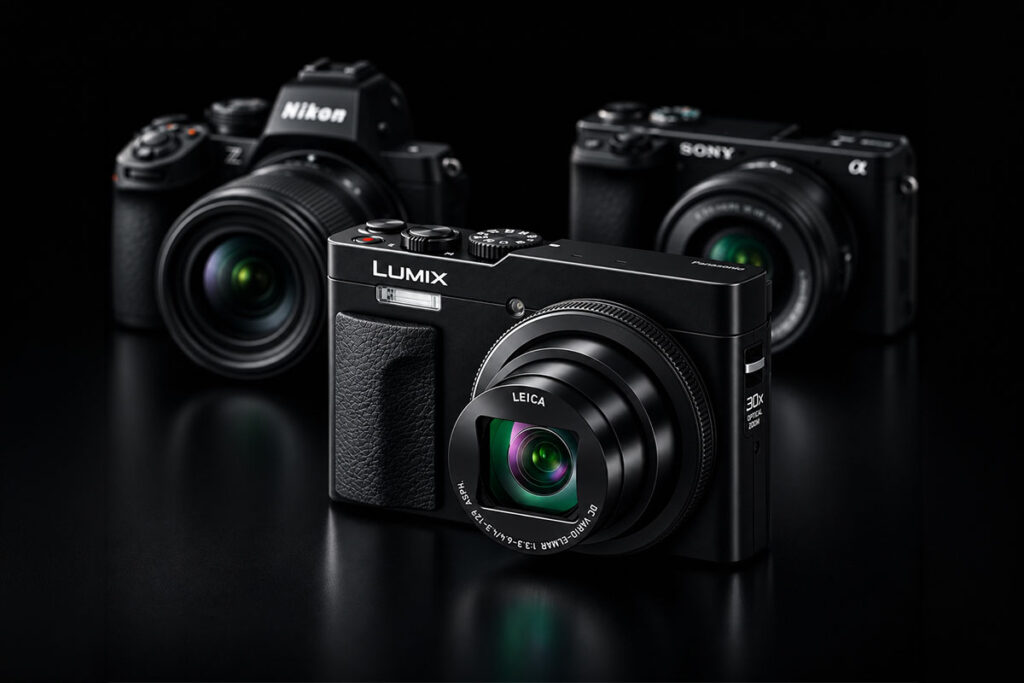
Image: LUMIX ZS99 Pocket-sized Travel and Lifestyle 4K Digital Camera with 30x Zoom, featured in an official press release image published by Panasonic.
The Panasonic Lumix TZ99, the European name for the ZS99, is designed for exactly that situation. It features a 20.3-megapixel 1/2.3-inch sensor and a built-in 30x optical zoom covering an equivalent focal-length range of 24–720mm.
That’s an enormous amount of reach for a pocketable camera. You can photograph a wide city scene one moment and zoom in on distant architectural details the next, without changing equipment.
But the small sensor is a significant limitation. Low-light photography can be challenging, and its image quality won’t necessarily outperform a good smartphone under every condition. Its biggest advantage is optical reach rather than pure sensor performance.
Related Posts



Previous Post
Next Post















Advertisement