




Now Reading: LEGO and Daft Punk Partnership: 3 Amazing Details Revealed
-
01
LEGO and Daft Punk Partnership: 3 Amazing Details Revealed

One mysterious red brick kicked off a partnership years in the making. LEGO has approved a fan-designed tribute to Daft Punk's Alive 2007 pyramid, with more announcements expected in 2027. But the bigger story is how a father, his son and a community of builders helped make it happen.
LEGO and Daft Punk fans got an unexpected surprise on October 21, 2026, when a mysterious red LEGO brick appeared in a cryptic teaser from the legendary electronic music duo. It was a standard 2×4 brick, shown from underneath so its three internal tubes resembled speaker cones. The 30-second transmission on “Daft Punk – WDPK 83.7” offered no clear explanation, just a curious clue that left fans guessing. One day later, the mystery was solved as the LEGO Group and Daft Punk officially announced a creative partnership blending music, culture and imagination.
The next day, the answer arrived. On October 22, the LEGO Group and Daft Punk announced an official partnership spanning products, content and brand experiences. At its center: a fan-designed version of the electronic duo’s famous Alive 2007 pyramid stage, approved to become a LEGO Ideas set.
There is something wonderfully appropriate about all this. The musicians who made anonymity theatrical are returning to the spotlight as tiny robots made of plastic bricks. And the spark came from a father and son building together at home.
A Cryptic Teaser, Followed by Two Familiar Robots
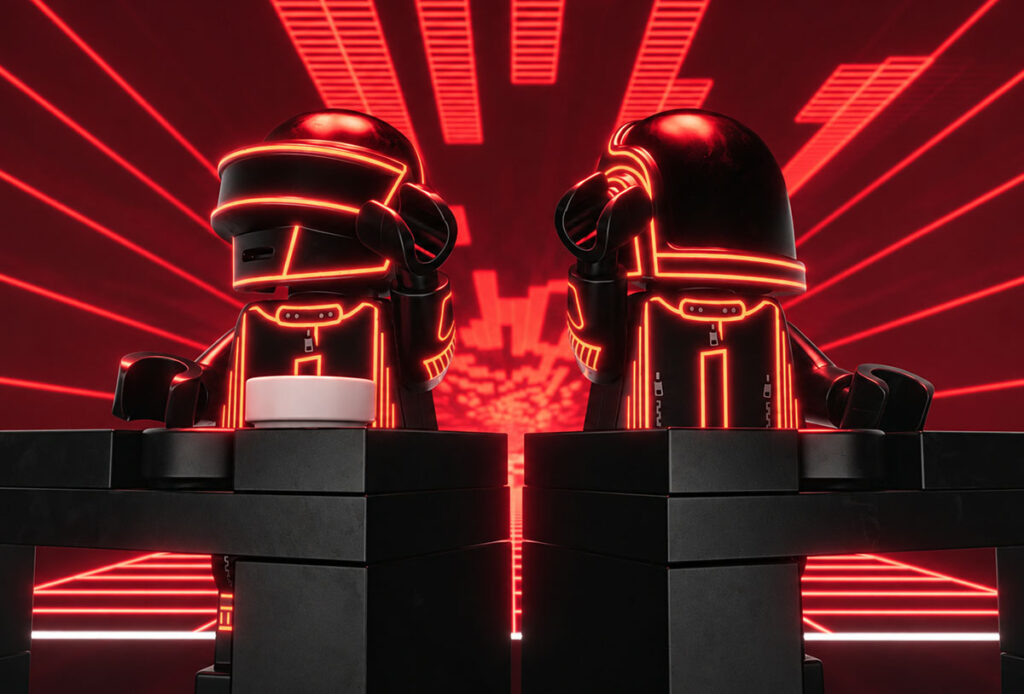
The announcement film doesn’t open with a product box or a price tag. Instead, LEGO minifigure versions of Daft Punk follow a holographic red brick through a shadowy digital world. Architecture assembles around them, piece by piece, until the pair reach a brick-built console. The soundtrack brings together “Voyager,” from 2001’s Discovery, and “Human After All,” the title track of the duo’s 2005 album. It’s a neat bit of sequencing. First the journey, then the joke: Builders After All.
This collaboration is about an artistic identity as much as music. Daft Punk’s helmets, silver-and-gold robot personas and meticulously designed stage productions are recognizable even without a song playing. LEGO, meanwhile, has a visual language just as immediate. A handful of studs can suggest almost anything. Put the two together and you don’t need to explain much. You can spot the crossover from across the room.
LEGO’s chief product and marketing officer, Julia Goldin, described the collaboration as “the beginning of a bigger journey” in the company’s October 22 announcement. That is the organization’s ambition, not proof of how many sets or events will eventually appear. The confirmed first step is the Ideas project; the wider plan includes future content and experiences, with more information promised in 2027.
And an important distinction matters here: Daft Punk are not announcing a reunion. Thomas Bangalter and Guy-Manuel de Homem-Christo ended their partnership as a musical duo on February 22, 2021, revealing the decision through the film Epilogue. The breakup was confirmed by their representative.
Their music and imagery have remained visible since then. The 2023 tenth-anniversary edition of Random Access Memories, for instance, included 35 minutes of previously unreleased recordings, according to Sony Music. A LEGO collaboration adds another way to experience that creative world. It does not, based on what has been announced, signal new recordings or live shows. That difference might even be the point. The robots can have a new adventure without asking the human musicians to reverse a decision they made five years ago.
The Pyramid Started With a Family, Not a Boardroom
To understand why this is more interesting than another licensed collectible, rewind to 2020. During lockdown, Patrick Harboun and his son, based in Luxembourg, recreated the pyramid at the heart of Daft Punk’s Alive performances. Their project, submitted under the name RobotRock, won the grand prize in LEGO Ideas’ Music to Our Ears challenge in May 2020. Contemporary reporting counted 2,109 fan votes. Yet winning the contest did not automatically make the model a retail product.
The original idea was wonderfully ambitious. A transparent-brick section could rotate with a motor while lights inside created an approximation of the real concert’s shifting colors. Tiny robot performers stood above the pyramid. Lighting trusses framed the scene. It was an attempt to capture not merely two famous helmets but an experience: the moment a stage seems to become part instrument, part spaceship.
The real pyramid deserves that attention. Daft Punk introduced the show at Coachella in 2006 and carried it into their 2007 tour. The illuminated structure transformed what could have been two people working at electronic equipment into something closer to science-fiction theater. As Rolling Stone documented, the show helped establish a new standard for large-scale electronic performances. The music was central, obviously, but the visuals also changed how audiences imagined a dance concert could look. That legacy is why the pyramid’s shape still means so much almost two decades later.
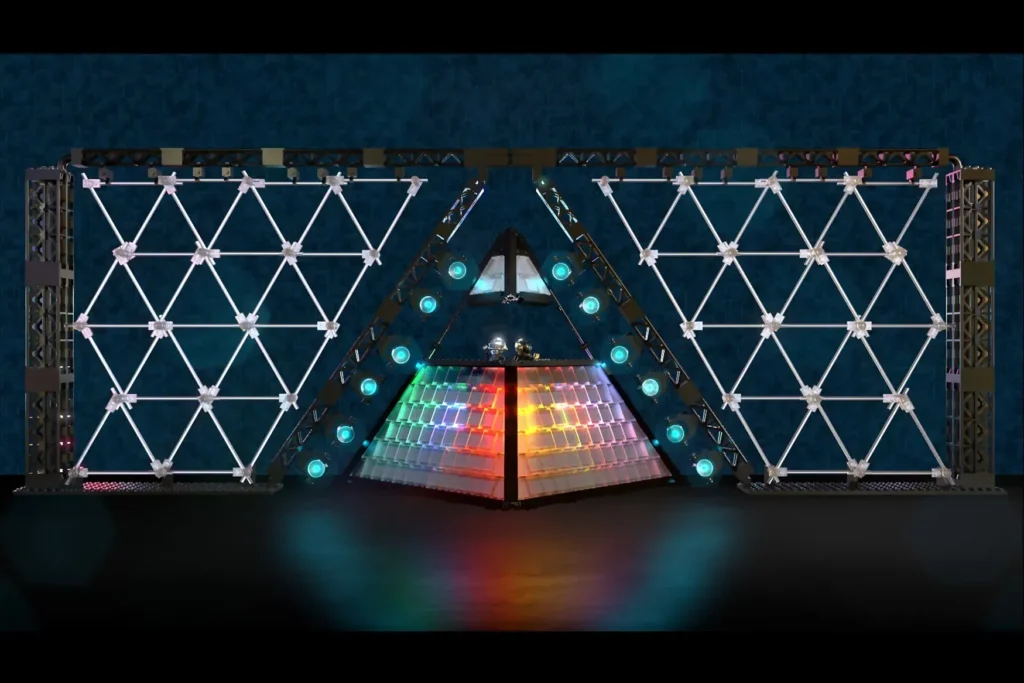
Image: Official press release image published by LEGO via the LEGO Newsroom. Fan model – not final product.
The LEGO proposal had another life, too. Harboun resubmitted it to LEGO Ideas in October 2024, and by spring 2025 it had reached 10,000 supporters, the threshold for formal review. This is a crucial detail: 10,000 supporters normally earn a review, not a guaranteed set. LEGO considers design, safety, playability and other practical factors before choosing what to manufacture.
In April 2025, DJ Mag reported that the pyramid had advanced to the review stage. Then, in October 2026, the company finally gave this particular model the green light for development. “We never dared imagine it would take off in this way,” Harboun said in LEGO’s official announcement.
It’s the kind of sentence that makes the scale of the partnership suddenly feel smaller, in a good way. Behind the licensing language is a parent and a child trying to make something they both love. Then thousands of strangers decided they loved it too.
The proposed fan model has been described in coverage as roughly 2,000 pieces, but that is not a confirmed specification for the eventual retail set. LEGO explicitly labels the concept imagery as a fan model, not the final product. Its official partnership FAQ says RobotRock will work with LEGO designers on the finished version. It gives no release date, final size or price.
So if you’ve seen a beautifully illuminated pyramid online and assumed that precise construction will be on shelves next year, not so fast. There’s a useful precedent here. Another creation from the Music to Our Ears challenge became the 1,074-piece LEGO Ideas Fender Stratocaster, released in October 2021. That model translated an iconic instrument into a display object, complete with an amplifier and foot pedal.
The Daft Punk pyramid asks a trickier question. How do you turn a moving, pulsating performance into a building experience without losing its energy?
Why This Unlikely Pairing Makes Sense
The connection actually has a longer history than the October teaser suggested. Daft Punk appeared in LEGO form in Pharrell Williams’s 2024 animated film Piece by Piece. And in an October 2026 interview with Wallpaper, Daft Punk creative director Cédric Hervet said his side had approached LEGO years earlier. The fan-built pyramid and its supporters, he explained, helped make the timing right.
Hervet also offered a line that puts the whole project in perspective:
A legacy doesn’t end when you stop making new work
Cédric Hervet, Daft Punk creative director
He was talking about Daft Punk, but it fits LEGO too. A box of bricks is rarely the end of the idea. People take it apart, rearrange it, show friends, change the colors, make an entirely different thing. A concert ends. A recording can be replayed. A LEGO model can be rebuilt, sometimes into something its original designer never imagined.
There is a business logic here, certainly. LEGO has spent years making sets that appeal to adults as well as children, and music fans are an obvious audience for display-worthy builds. Daft Punk’s iconic silhouettes are practically made for a miniature collector’s shelf. There is also an opportunity to introduce younger builders to an influential electronic music act whose most famous performances happened before some of them were born.
But the more distinctive opportunity, to my eye, is participation. The collaboration can give fans something to do with a memory rather than simply something to buy bearing a familiar logo. That makes it different from another anniversary reissue or a limited-edition piece of merchandise.
What’s Confirmed — and What’s Still a Possibility
As of November 3, 2026, the lines are fairly clear:
- Confirmed facts: LEGO and Daft Punk announced the partnership on October 22. The promotional film uses “Voyager” and “Human After All.”
- Confirmed product development: The fan-designed Alive 2007 pyramid has been selected for LEGO Ideas development, with the original creator involved.
- Announced future plans: The partners intend to explore additional content, events and brand experiences. They say more details are coming in 2027.
- Not announced: A retail launch date, price, final piece count, finished product design or Daft Punk reunion.
- Prediction, not a promise: Lights, motion or other interactive features could make the set particularly compelling. None has been confirmed for the final version.
The distinction matters because early fan creations can look remarkably polished. Photographs and digital renders travel quickly online, and excitement can easily turn a proposed feature into something people assume is guaranteed. But an approved design isn’t the same thing as a finished product.
The Hard Part Is Making the Feeling Fit
A concert stage does things bricks alone cannot. It flashes in time with music. It towers over a crowd. It overwhelms your senses, in the best possible way. Engineering a stable, affordable model that hints at all that is a real design challenge, especially when the source material is remembered as much for its atmosphere as its appearance.
So is producing robot helmets that satisfy fans who notice every curve. And so is finding the right balance between a model built for display and one that people actually enjoy assembling. A beautifully detailed static pyramid might please collectors, while a design with working lights or moving elements could better capture the energy of the original show. Every extra feature, though, introduces questions about engineering, complexity and cost.
The wider partnership has similar choices ahead. Events and animations could reach listeners who have never owned a LEGO set. More products might let fans explore different moments from the duo’s visual history. A digital experience could even provide a different way to connect music and construction. Those are possibilities, though, not a published roadmap, and the companies haven’t specified which directions they will pursue.
Too many generic collectibles could also dilute the very sense of care that made Daft Punk’s imagery special. The people behind this collaboration will need to resist that temptation. There is another risk worth admitting: nostalgia is not automatically creativity. A miniature pyramid can look fantastic while asking very little of its owner beyond following instructions.
But if LEGO and Daft Punk preserve some of the original fan project’s tinkering spirit—the movement, the surprise, the pleasure of making something from available pieces—they have a chance to create an object that does more than commemorate a tour. The fact that the project began with fans rather than a traditional product pitch makes that possibility especially interesting.
For now, the most telling image may not be the robots at their new console. It’s that first red brick, with three hollow tubes looking unexpectedly like speakers. Nothing exotic. Just an ordinary piece seen from a different angle, and suddenly a different idea becomes possible.
Related Posts


Previous Post
Next Post
Previous Post

Next Post






Advertisement


