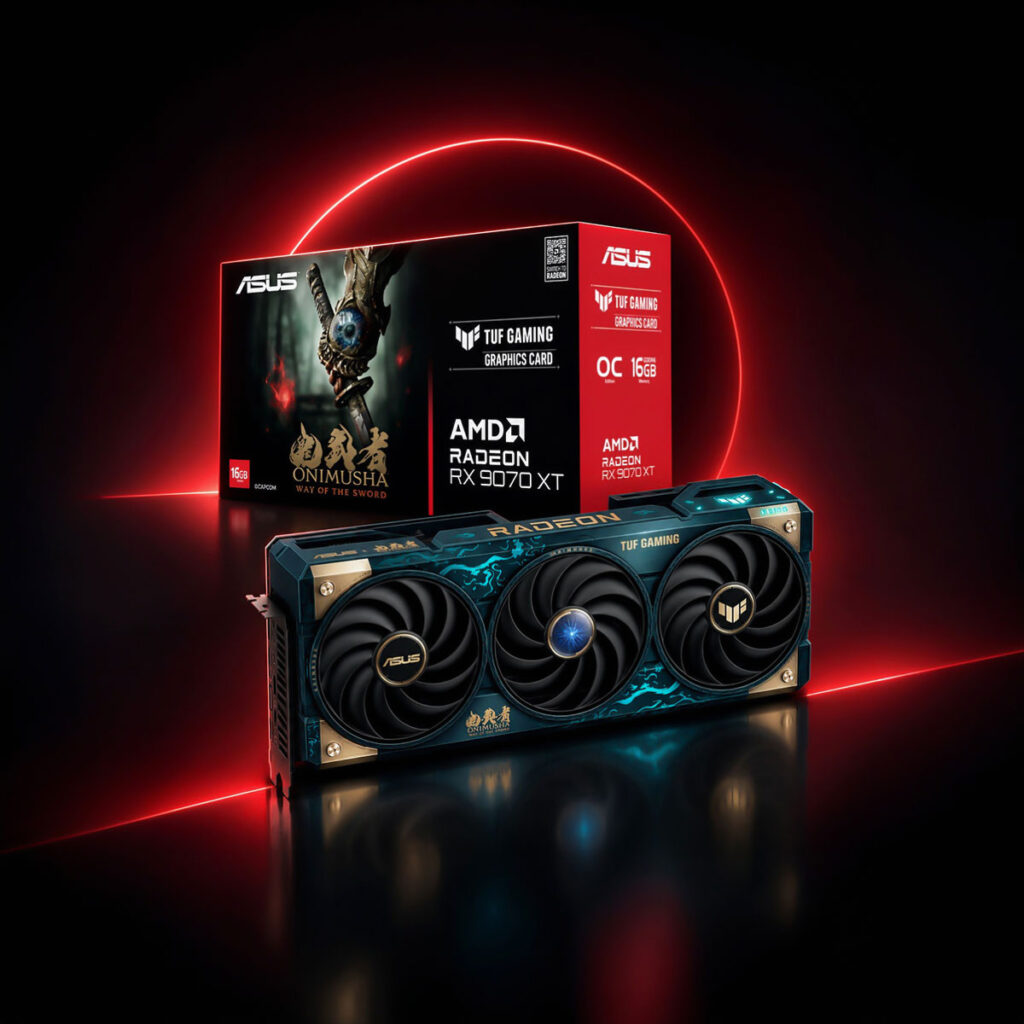
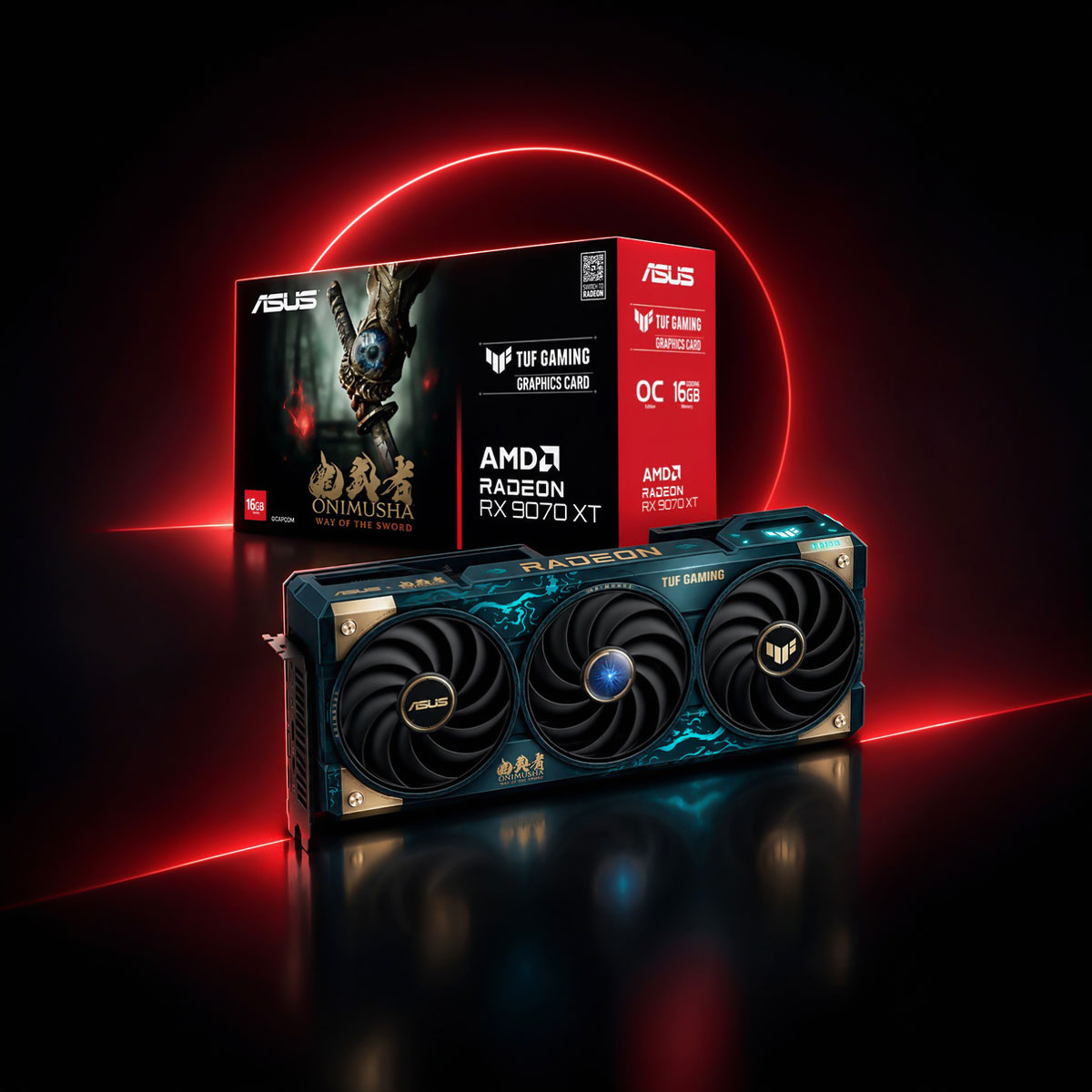
There’s a fridge magnet in the box. An Onimusha-themed one, to be precise. Not exactly what you’d expect alongside a powerful graphics card packing three cooling fans, 16GB of video memory, and enough physical bulk to occupy more than three expansion slots. But that’s part of the charm of the ASUS TUF Gaming Radeon RX 9070 XT Onimusha Special Edition, a limited-edition GPU that combines serious gaming hardware with collectible artwork inspired by Capcom’s Onimusha – Way of the Sword.
Created in collaboration with AMD and Capcom, this graphics card trades the familiar industrial appearance of ASUS’s TUF Gaming series for a dramatic blue-and-gold design influenced by Japanese fantasy. There’s samurai imagery, supernatural symbolism, and plenty of attention to the details that Onimusha fans will recognize. Underneath, though, the hardware is surprisingly familiar. ASUS isn’t introducing a new graphics architecture or promising extraordinary performance gains. Instead, it’s giving an existing high-performance Radeon GPU a distinctive identity, and that raises an interesting question: how much is a beautifully designed special edition actually worth?
An Onimusha-Inspired ASUS TUF GPU With a Story Behind It
The inspiration comes from Onimusha – Way of the Sword, Capcom’s return to a franchise that began in 2001. The series built its reputation around sword-based combat, supernatural enemies, and historical Japanese settings, eventually becoming one of Capcom’s recognizable action franchises. After a lengthy absence of major new installments, the arrival of Way of the Sword gave longtime fans something substantial to celebrate.
In its September 7, 2026, official announcement, Capcom described the game as the “first new title in the series in over 20 years.” The story follows legendary swordsman Miyamoto Musashi through a dark fantasy interpretation of Edo-period Kyoto, where creatures known as Genma threaten the city. Musashi’s supernatural Oni Gauntlet plays an important role in the adventure, and ASUS has made that artifact central to the graphics card’s visual identity.
The custom shroud and backplate feature a striking combination of blue, gold, and darker metallic tones. Rather than relying on a simple printed game logo, ASUS has incorporated imagery inspired by the Oni Gauntlet and the broader world of Onimusha. The result feels noticeably different from a conventional black or grey gaming GPU, particularly in a PC case with a tempered-glass side panel. It’s decorative, certainly, but the angular cooler and three-fan construction still retain the recognizable TUF Gaming character.
Gaming isn’t just about powerful hardware and high frame rates. It’s about stepping into another world and experiencing every moment at its best Magazine SAVVY
ASUS describes the card as “a true showpiece for collectors” in its October 27, 2026, press release. That’s the company’s promotional assessment, rather than an independent verdict, but the design does offer more personality than many typical branded collaborations. The hardware becomes part of the visual presentation of a gaming setup, not merely the component responsible for producing the images on screen.
The timing of the collaboration is also worth understanding. ASUS initially showcased the special edition at Gamescom in August 2026, with another appearance around Tokyo Game Show in September. The company followed up with its formal October announcement. Meanwhile, Capcom had moved the game’s release date forward from September 25 to September 4, 2026, meaning the title was already available when ASUS issued its latest announcement.
The comeback has been commercially meaningful, too. According to Capcom’s September 7 announcement, Onimusha – Way of the Sword sold more than one million copies on its first day, helping push cumulative series sales beyond 10 million. Those are publisher-reported figures, but they demonstrate the audience behind the collaboration. ASUS isn’t simply attaching graphics to an obscure game. It’s tapping into an established franchise with renewed attention and a dedicated fan base.
Radeon RX 9070 XT Performance Beneath the Samurai Artwork
Remove the visual styling from the equation, and the Onimusha Special Edition is essentially an ASUS TUF Gaming Radeon RX 9070 XT OC graphics card. It uses AMD’s RDNA 4 architecture, originally introduced with the Radeon RX 9000 series in 2025. This generation brought improvements to ray tracing, AI-assisted graphics features, and rendering performance, making the RX 9070 XT a competitive option for demanding 1440p gaming and capable 4K performance.
According to ASUS’s official technical specifications, the special edition includes:
- GPU: AMD Radeon RX 9070 XT with RDNA 4 architecture
- Stream processors: 4,096
- Video memory: 16GB GDDR6 with a 256-bit memory interface
- Memory speed: 20Gbps
- GPU clocks: Up to 3,060MHz boost in default mode and 3,080MHz in OC Mode
- Connectivity: PCIe 5.0, one HDMI 2.1b port, and three DisplayPort 2.1a connections
- Cooling: Three Axial-tech fans and a phase-change GPU thermal pad
- Dimensions: 330 × 140 × 62.5mm, occupying 3.125 expansion slots
- Power: Three 8-pin connectors and an ASUS-recommended 850W power supply
These figures are impressive enough for a modern gaming card, but there’s an important detail: the Onimusha edition shares its published clock speeds, memory configuration, and dimensions with the regular TUF Gaming RX 9070 XT OC Edition. Buyers shouldn’t expect additional performance simply because the artwork is different. The improvements are primarily visual and collectible rather than architectural.
That doesn’t make the underlying GPU any less interesting. In a 52-game comparison published in May 2026, TechSpot found the Radeon RX 9070 XT delivering performance remarkably close to Nvidia’s GeForce RTX 5070 Ti. At 1440p, Nvidia held an average advantage of approximately 1.4%, while the gap increased to roughly 4% at native 4K. Those are relatively small differences across such a broad collection of games, although individual results varied considerably.
Some titles favored Radeon, particularly in conventional rasterization, while others gave Nvidia a noticeable lead when heavier ray-tracing or path-tracing effects were enabled. GamersNexus summarized the competitive situation in its original RX 9070 XT review with a refreshingly simple observation: “There’s real competition now.” That’s an important point for potential buyers. The GPU has meaningful gaming credentials even without its Onimusha styling.
Of course, these independent benchmarks involve other RX 9070 XT cards, not direct testing of this particular special edition. They provide a useful picture of the GPU architecture’s capabilities, but they shouldn’t be mistaken for verified frame-rate results from the Onimusha model itself.
Cooling, Durability, and Real-World Considerations
ASUS has retained the familiar TUF cooling approach, with three Axial-tech fans mounted above a substantial heatsink. The design incorporates a phase-change thermal pad intended to improve heat transfer between the graphics processor and cooling assembly. A vented metal structure helps hot air escape, while the large cooler provides the surface area needed to manage heat during demanding gaming sessions.
Additional features include dual-ball fan bearings, reinforced GPU mounting, protective PCB coating, and a dual-BIOS arrangement for selecting different operating profiles. ASUS promotes these features as contributing to durability and sustained performance, although independent testing of the exact Onimusha edition would be needed to establish its actual temperatures, noise levels, and long-term behavior. Manufacturer engineering claims and measured results aren’t quite the same thing.
There are practical considerations, too. At 330mm long and more than three slots thick, this card requires a reasonably spacious PC case with adequate airflow. Its three 8-pin power connectors also make cable management worth thinking about, especially in a build designed to showcase the artwork. ASUS recommends an 850W power supply, although the appropriate capacity ultimately depends on the complete system configuration.
The GPU also supports AMD FidelityFX Super Resolution technologies, including the machine-learning-based FSR 4 capabilities associated with RDNA 4. Compatible games can use upscaling to improve the relationship between image quality and frame rates, particularly at higher resolutions. However, supported features vary between games, and there’s no indication that the Onimusha edition receives exclusive software improvements unavailable to other RX 9070 XT owners.
Collector Extras, Euro Pricing, and the Question of Value
The special-edition package includes more than a redesigned graphics card. ASUS bundles a standard PC edition of Onimusha – Way of the Sword through a Steam redemption arrangement, giving buyers the game connected to the card’s appearance. Other accessories include an Onimusha-themed graphics card holder, fridge magnet, hook-and-loop strap, sticker, and a TUF reliability certificate.
The card holder is arguably the most practical addition, given the GPU’s size and weight. The remaining accessories are mostly about presentation and ownership, which is exactly what you’d expect from a collector-focused product. None will improve frame rates, naturally, but they make the complete package feel more deliberate than a normal graphics card with different colors.
A great graphics card delivers more than stunning visuals. It brings every battle, every adventure, and every gaming moment to life
Magazine SAVVY
Pricing is where things become more complicated. As of October 31, 2026, ASUS has not confirmed an official European retail price, worldwide production quantity, or general availability date for the Onimusha Special Edition. That makes it difficult to determine whether the collector package represents reasonable value.