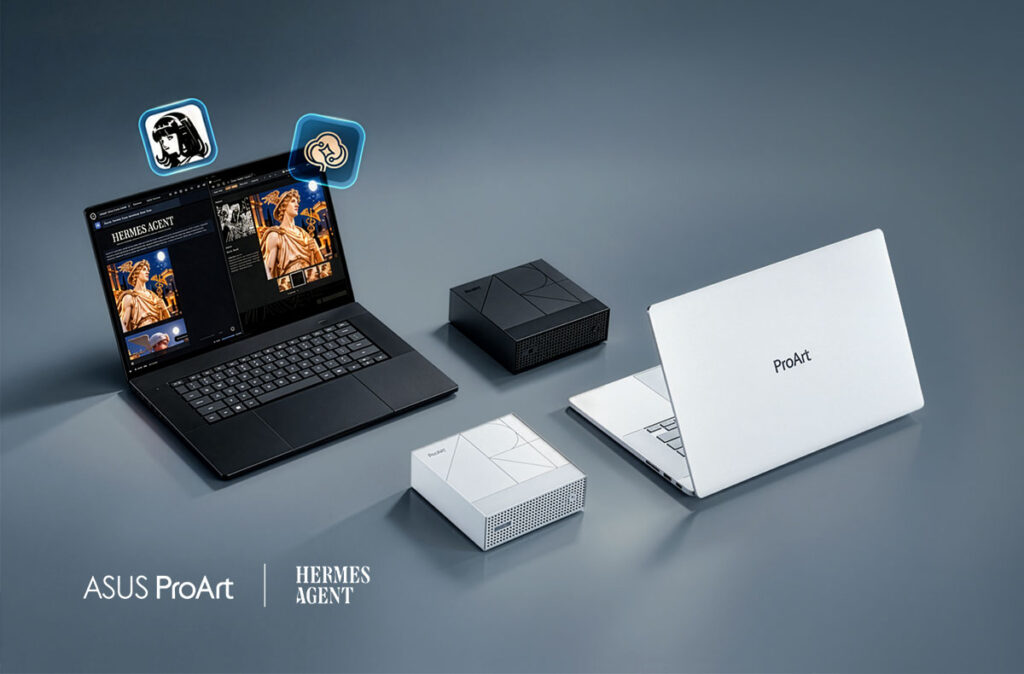
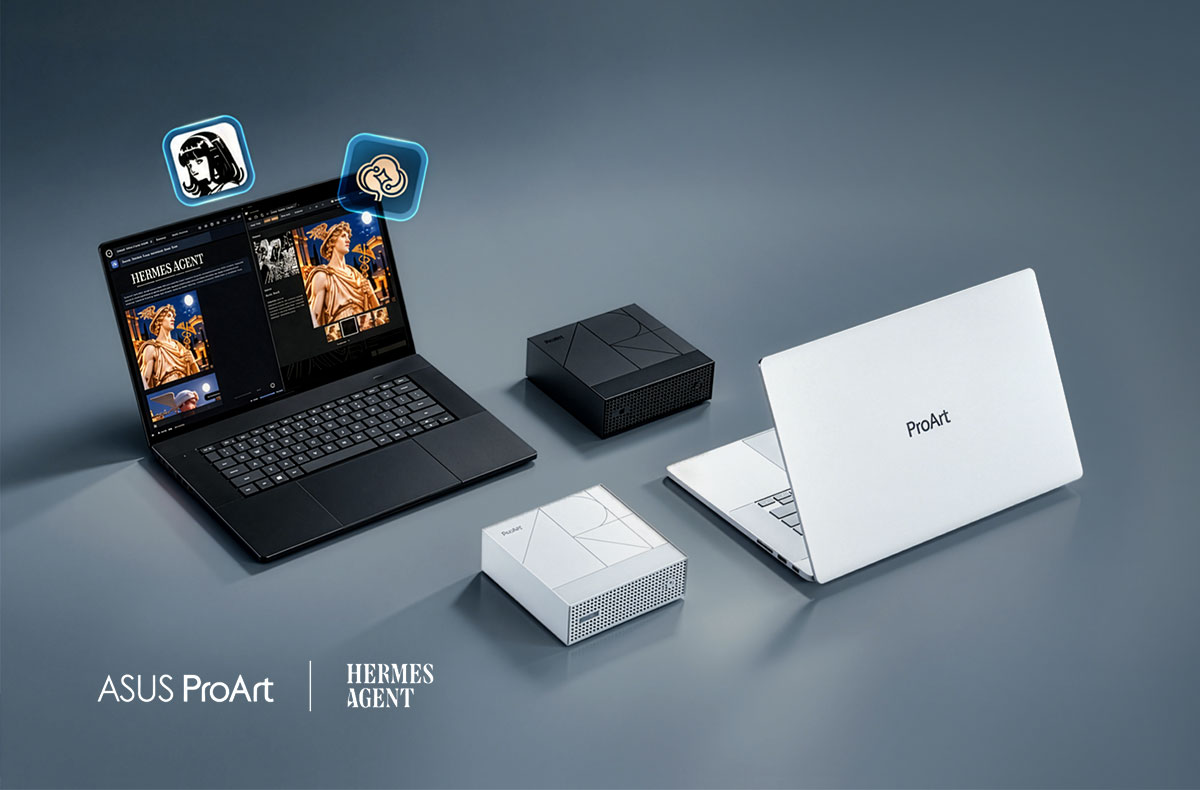
An ASUS ProArt P16 with 128GB of unified memory has just done something rather unexpected. In an October 29, 2026, test by PCWorld, the laptop completed a demanding AI research workload in 33 minutes and 13 seconds. A powerful desktop equipped with NVIDIA’s GeForce RTX 5090 needed 52 minutes and 51 seconds to finish a comparable task. Not bad for a machine weighing less than 1.8kg.
The surprising part isn’t that the ASUS laptop has a faster graphics processor. It doesn’t. Its advantage comes from a different approach to memory, allowing enormous AI models to run locally without the limitations of a conventional discrete GPU setup. A 128GB ProArt P16 configuration with 2TB of storage has been listed for €6,699 in Germany, so this is clearly premium territory. But the technology behind it could change how creative professionals work.
ASUS is betting that future Windows PCs will do considerably more than run familiar applications. They’ll generate images, process enormous datasets, manage creative projects, and support AI agents that handle complex tasks without constantly relying on cloud services. With the new ProArt RTX Spark lineup, that idea is moving from product demonstrations into actual laptops people can buy.
How ASUS ProArt RTX Spark PCs Became a Reality
The story really picked up on May 31, 2026, when NVIDIA and Microsoft introduced RTX Spark at GTC Taipei. The companies presented it as a new computing platform combining NVIDIA’s Grace CPU, Blackwell RTX graphics, and Microsoft’s Windows operating system. Unlike traditional performance laptops, RTX Spark was designed around local AI processing and intelligent agents from the beginning.
NVIDIA CEO Jensen Huang described the company’s ambition in unusually simple terms:
With RTX Spark and Microsoft Windows, you ask — and the PC does the work
Jensen Huang, NVIDIA founder and CEO
ASUS followed on June 1, unveiling its ProArt RTX Spark family at Computex 2026. Additional demonstrations appeared at IFA in September, and global preorders began October 7. By October 16, the ProArt P14 and P16 were officially available for purchase in the United States, with European retailers also listing configurations. These are no longer simply future concepts, although availability still depends on the model and country.
Meet the ProArt P14, P16, and GR1X
The ASUS ProArt RTX Spark lineup currently consists of three announced machines, each targeting a slightly different working environment.
- ASUS ProArt P14 (H7407BA): A compact 14-inch laptop weighing approximately 1.48kg, with a 3K OLED touchscreen, up to 128GB of unified memory, and a battery capacity of up to 90Wh. It’s designed for creators who want substantial computing capabilities without carrying a bulky workstation.
- ASUS ProArt P16 (H7607BA): A larger 16-inch model weighing approximately 1.77kg, featuring a 4K OLED touchscreen with a 120Hz refresh rate, up to 128GB of unified memory, and a 99.9Wh battery. Its larger display makes it especially interesting for video editing, design, and complex creative projects.
- ASUS ProArt GR1X Mini PC: A compact desktop measuring approximately 150 × 150 × 51mm, designed for local AI agents and studio workflows. ASUS has announced features including 10GbE networking, support for four 4K displays, and configurations with up to 128GB of memory.
The two laptops are commercially available, while ASUS has described the GR1X as a planned late-2026 release. That difference is worth remembering when comparing the devices. The GR1X may eventually become an appealing option for users who want local AI processing permanently available at their desks, but its availability shouldn’t be confused with the confirmed laptop launch.
What Makes RTX Spark Different From Other Windows PCs?
Most powerful Windows laptops follow a familiar formula. A processor handles general computing tasks, system RAM stores application data, and a dedicated graphics processor handles demanding graphics or AI operations using its own video memory. That arrangement works extremely well for gaming, rendering, and plenty of professional software, but large AI models can expose its limitations.
RTX Spark approaches the problem differently. Its NVIDIA Grace CPU and Blackwell RTX GPU use a shared pool of unified memory, connected through NVIDIA’s NVLink-C2C technology. Instead of relying entirely on separate CPU and GPU memory pools, the architecture allows both processors to work with a large shared memory resource.
According to NVIDIA’s official specifications, the higher-end RTX Spark platform offers a 20-core Grace CPU, a Blackwell GPU with 6,144 CUDA cores, and fifth-generation Tensor Cores supporting FP4 calculations. Some lower-priced configurations use an 18-core CPU and 5,120 GPU cores, so performance specifications vary across the range.
The major capabilities include:
- Up to 128GB of unified memory for demanding local AI workloads.
- Up to 1 petaflop of FP4 AI compute performance under supported low-precision workloads.
- NVIDIA CUDA, TensorRT, OptiX, DLSS, and other RTX technologies.
- Support for large language models, image generation, video processing, and demanding creative applications.
A petaflop sounds extraordinary, but it needs context. NVIDIA’s headline figure refers to a specific type of low-precision AI computation, not universal performance across every application. Likewise, 128GB of unified memory doesn’t mean every byte is automatically available to the GPU. Memory allocation and application requirements still matter.
Where the architecture becomes especially useful is with large models. NVIDIA and ASUS say suitable RTX Spark configurations can run language models containing approximately 120 billion parameters locally, depending on quantization, model architecture, available memory, and context length.
The PCWorld comparison offered a practical example. Reviewer Brad Chacos ran a substantial research workload using the gpt-oss-120b model. With approximately 96GB allocated to graphics processing, the ProArt P16 handled the enormous model more efficiently than the RTX 5090 desktop, which had to work across separate pools of system memory and its 32GB of dedicated VRAM.
That doesn’t make RTX Spark universally faster. The RTX 5090 remains considerably more powerful for many workloads that fit comfortably within its video memory. But for unusually large local AI tasks, the ProArt’s memory architecture can provide an important advantage.
AI Agents Could Be More Important Than the Hardware
The bigger ambition isn’t simply running enormous language models. ASUS wants these computers to support AI agents capable of working with files, applications, and creative tools. Instead of asking an assistant to generate a paragraph or answer a question, users could build workflows where multiple tasks happen with less manual intervention.
ASUS is developing this idea through its software ecosystem. MuseTree supports AI-assisted image creation, while StoryCube helps organize and search media collections. ProArt Creator Hub provides performance and system controls, and ASUS has also introduced Zenni Claw for assistant-driven productivity tasks.
The company has announced partnerships involving ComfyUI and Hermes Agent from Nous Research. ComfyUI allows users to build visual AI workflows, while Hermes is designed to coordinate actions and tools. The intention is to make sophisticated local automation more accessible to creators who don’t necessarily want to write complicated scripts.
Yoland Yan, CEO and co-founder of Comfy, explained the attraction:
Creators want to run the best AI models on their own machines, with full control
Yoland Yan, ASUS press announcement
Consider a freelance filmmaker managing hundreds of video clips. A potential local workflow might involve identifying relevant footage, generating visual references, organizing assets, and preparing material for editing. Some of these capabilities already exist independently, while the more ambitious agent-driven connections are still developing. There’s a difference between a supported feature and a completely reliable automated production pipeline.
The software ecosystem is making progress, however. NVIDIA confirmed on October 16 that native RTX Spark support was available through beta versions of Adobe Photoshop and Premiere, with additional creative application support planned. Native PyTorch-CUDA support on Windows-on-Arm also makes the platform more interesting for AI developers.