



Now Reading: Electric Motorsport: Thrilling Speed, Tough Questions
-
01
Electric Motorsport: Thrilling Speed, Tough Questions
Electric Motorsport: Thrilling Speed, Tough Questions

Electric race cars are no longer experimental novelties. They launch faster than many combustion racers, recover huge amounts of energy and promise useful road-car lessons. But batteries, minerals, freight, public attention and ambitious sustainability claims make the future of electric motorsport far more complicated—and far more interesting.
The first Formula E race ended with a car in the air. On 13 September 2014, at Beijing’s Olympic Park, Nick Heidfeld went for a last-corner move, collided with Nicolas Prost and was pitched towards the barrier. Lucas di Grassi inherited the win. The sport sold itself as clean and futuristic. Its opening scene was pure motorsport: risk, bad luck, and a driver climbing out of a wreck.
That contrast still explains electric racing better than most launch videos do. The cars are now startlingly quick. Formula E’s next-generation GEN4 machine is scheduled to reach about 335 km/h and to do 0–100 km/h in roughly 1.8 seconds. It will use permanent all-wheel drive and recover up to 700 kW under braking, according to the series’ published specification. The sound is different. The arguments are not.
Electric motorsport has moved from clever experiment to serious engineering contest. It has also inherited a difficult brief: make speed exciting, make the technology useful, and reduce the impact of carrying batteries, people and equipment around the world. That is a lot to ask of one car.
The race got fast before it got familiar
Formula E began as a 2011 dinner conversation between Alejandro Agag and former FIA president Jean Todt. The napkin idea became the first all-electric international single-seater championship in three years. The inaugural race took place in Beijing; the championship’s official history records the date, crash and di Grassi’s win.
The early battery could not last a full race, so drivers changed cars halfway through. Dramatic, but awkward. GEN2, introduced in 2018/19, ended the swap and added ATTACK MODE: leave the best racing line for a temporary power boost.
GEN3 arrived in 2022/23 with a front powertrain and up to 600 kW of regenerative braking. GEN3 Evo followed in 2024/25: 0–100 km/h in 1.86 seconds, 0–60 mph in 1.82 seconds, a 322 km/h top speed, and all-wheel drive during starts, qualifying Duels and ATTACK MODE. Formula E’s generation-by-generation record lays out the progression.
So when somebody says electric race cars are slow, they are remembering the wrong decade. The final GEN3 Evo season ended in 2025/26 with Porsche’s Pascal Wehrlein taking the Drivers’ title and Jaguar TCS Racing the Teams’ title. That is the confirmed result. The next step is still a plan.
Formula E says GEN4 will make its competitive debut in 2026/27 with:
- 450 kW in standard race mode and up to 600 kW in ATTACK MODE.
- Up to 55 kWh of usable race energy and 700 kW of regenerative braking.
- Permanent active all-wheel drive, two aerodynamic configurations and a projected top speed of 335 km/h.
- More than 40% of race energy recovered through braking, plus construction intended to be 100% recyclable or reusable and contain at least 20% recycled material.
Those are announced specifications and targets, not race-proven results. The official GEN4 guide is the source for the figures; the stopwatch will have the final word.
The car may be nearly silent. The questions around it are getting louder -Magazine SAVVY
Energy is the strategy
The defining skill is deciding when not to use all the available power. A driver brakes, sends energy back into the battery, protects the tyres, follows a consumption target and still defends the next corner. Racing with a calculator in the background. A very fast calculator.
ATTACK MODE makes that calculation visible. The driver leaves the fastest line, loses time, then gets extra power. In the announced 2026/27 format, the 30-minute E-PrixUnleashed sprint will have six minutes of ATTACK MODE and no pit boost. The standard 45-minute E-Prix will require PIT BOOST, a 30-second charge Formula E says adds 10% battery power. The current race guide explains the split.
This is where the sport becomes distinctive. In Formula E, braking is part of the supply chain. Every overtake changes the energy plan. A Safety Car can rescue a strategy or ruin it. A small mistake can leave a driver with plenty of speed and not enough usable power.
The technology is also supposed to travel beyond the circuit. Lucas di Grassi, who raced in Formula E from its first season through his retirement after 2025/26, told Reuters: “The main goal is that the technologies we develop here can be implemented in millions of road cars.”
There are tangible examples, with careful wording. Formula E and Reuters report Nissan race learning helped increase the Leaf’s battery capacity by 181% and range by 184%; Jaguar reports road-car efficiency gains of up to 10% from race-derived software. Those are manufacturer and series-reported results. The useful transfer is often less glamorous: cooling, inverters, software, packaging and thermal control.

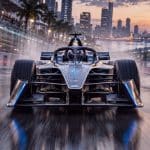
Illustration created with Adobe Firefly for illustrative purposes.
The green promise has footnotes
An electric race car has no tailpipe exhaust. That matters in city centres. It does not mean the event has no emissions: electricity, batteries, freight, travel, grandstands and hospitality all count.
The wider evidence supports electrification, with conditions. The European Environment Agency says a typical European electric car produces fewer life-cycle emissions and air pollutants than an equivalent petrol or diesel car, despite higher production emissions. A 2025 ICCT assessment reported by Reuters estimated 73% fewer life-cycle greenhouse-gas emissions for European battery-electric cars than comparable petrol cars. Those are road-car studies, not a Formula E weekend’s scorecard.
Formula E has added structure to its claims. In 2025 it announced that an independent audit certified the championship to the British Standards Institution’s Net Zero Pathway. Targets include cutting Scope 1 and 2 emissions by 50% and Scope 3 by 27.5% by 2030 against a 2018/19 baseline, with net zero targeted ideally by 2040 and no later than 2050. That is a certification and reduction plan, not proof that racing is impact-free.
Then there are the materials. The IEA’s 2025 critical-minerals outlook says lithium demand rose nearly 30% in 2024, with battery supply chains still concentrated. Electric racing is not outside that system; it is a high-stress customer of it.
The honest split looks like this:
- Confirmed fact: regenerative braking is now a central part of Formula E’s race performance, and the cars have become much faster since 2014.
- Organization statement: Formula E presents GEN4’s recyclable construction and its energy-recovery figures as proof that speed and lower impact can coexist.
- Announcement and future plan: GEN4, PIT BOOST and the 2026/27 calendar are scheduled developments; they still have to survive real races, real weather and real logistics.
- Prediction: the next gains will come less from simply adding power than from better energy density, charging, thermal management and material recovery.
- My analysis: electric racing is most credible when sustainability is a hard engineering constraint, not a sticker over a conventional travelling circus.
That is the tough question. A bigger battery adds weight; a smaller one demands more saving. Charging improves strategy but adds infrastructure. There is no clean shortcut. The trade-offs are the story.
A sport still trying to be a sport
Electric motorsport has a storytelling problem. The old engine noise is gone, so speed has to arrive through camera work, driver personalities, close racing and the energy graph. A high-pitched electric whine can sound like a fighter jet. To a sceptic, it can sound like an expensive appliance having a bad day.
The racing is not the weak link it was. At Berlin in 2025, the lead changed 16 times in one race, yet the audience has not grown in proportion to the technical progress. Florian Modlinger, Porsche’s Formula E team principal, told The Guardian: “It is a fact that it’s not gathering the attention that one might expect after 11 seasons.”
Formula E cannot solve that by pretending to be Formula 1 with different batteries. Its identity is more specific: city streets, short races, close cars, tactical energy use and a technology contest that must answer for its materials. CEO Jeff Dodds told the same paper: “We’ve got to carve our own furrow.”
Electric racing is most credible when sustainability is a hard engineering constraint, not a sticker over a conventional travelling circus -Magazine SAVVY
The announced 2026/27 calendar runs to 21 rounds across 13 events in 11 countries, with a short performance sprint and a longer, charging-sensitive race. That could broaden the audience, or make the rulebook feel even busier. My prediction: the series needs both the spectacular clip and the clear explanation. A driver taking a risky line for power is a story; a paragraph of regulations is not.
Previous Post
Next Post








Advertisement

-
 01LISA in 2026: How “SaWaDiKa” Turns a Thai Hello Into a Powerful Solo Statement
 -
 02The Remarkable 2027 Travel Forecast: Five Destinations Set to Thrive
 -
 03Electric Motorsport: Thrilling Speed, Tough Questions
 -
 04Is the Sony A7 III Still Worth Buying in 2026—and Into 2027?
 -
 05Graphic Design Tools 2026 Powerful Picks Worth Your Time